The Feelings Gym: How to Expand What You Can Build
When I was younger, there were times I'd be at a bar, see a woman I was attracted to and really want to go talk to her.
Then my stomach or throat would tighten and I wouldn't go.
Later in life, I came to realize it was just because I didn't want to feel that tightening and I let that limit me.
When you look at it that way, most people's lives are limited by which physical sensations they're willing to experience in their body.
After almost 20 years of coaching some of the world's most successful founders, I've found this shapes far more of what people do than they realize.
Which is why your capacity to feel actually sets the ceiling for what you can build.
And it's a ceiling you can raise.
The Law of Expanding Possibilities
In the book I'm writing, The Unicorn Mindset: Seven Secrets of the Most Successful Entrepreneurs, this is secret number two: raise your emotional ceiling.
Unfelt feelings keep unwanted patterns in place. You can see it in the things you know you should do but keep avoiding.
You stick with a project that isn't working because you don't want to feel the sadness of letting it go. You hesitate to fire someone because you don't want to feel the fear of their reaction. You tolerate team members showing up late because you're not comfortable with anger. You pass on the big, bold bet because you don't want to feel the shame of being wrong.
I call the relationship between emotional capacity and what's possible The Law of Expanding Possibilities. It states that the scope of what's possible for you is directly correlated with your capacity to be with intense feelings.
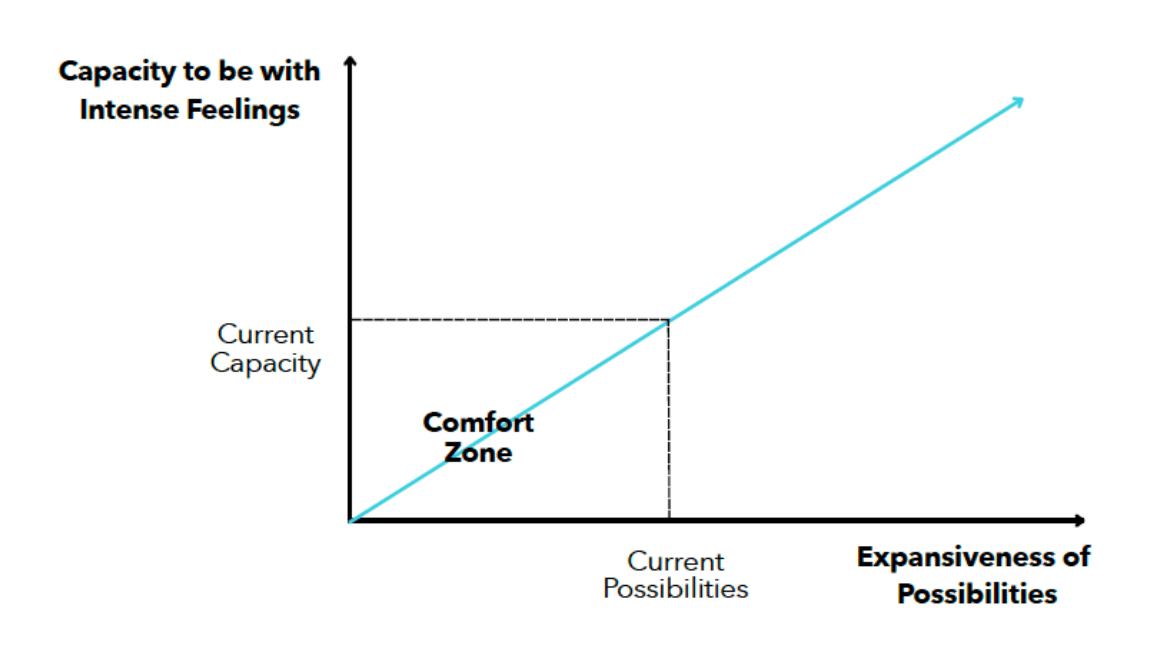
The edges of your comfort zone are defined by the intensity of feelings you're willing to experience.
And every time you expand your vision, raise more capital, grow your team or take on bigger customers, the emotional intensity increases. If your capacity doesn't grow with it, one of three things tends to happen: you shrink your vision, you escape into coping behaviors like overworking and overthinking, or you collapse under pressure.
Part of what keeps capacity from growing is that we tend to sort our feelings into good and bad. For most of my life, I thought joy was good and fear, anger and sadness were bad. Every time sadness would arise, I'd resist it and it would feel really painful. So I'd resist it more, because sadness was painful and I didn't want to feel it.
What I've come to see is that the pain comes from resisting emotions. When we label certain emotions as bad or painful, we always resist them, so we always experience them as painful. We end up caught in a self-fulfilling loop that isn't actually true, but we feel right about it.
And as long as we're caught in it, our capacity stays where it is.
Training in Your Feelings Gym
Capacity grows the same way strength does. It helps to think of your startup as your feelings gym. When you strength train, you add weight to the bar because that's how you get stronger. And the stronger you get, the more you can lift.
Every rep starts with noticing when you're avoiding a feeling. That's tricky, because most of the time we don't even recognize what we're feeling. It arises, and instead of being with it, we escape into our minds. There are three tells I find useful:
- Looping thoughts. When your mind keeps ruminating, it's trying to figure out how to control reality so you no longer have to feel something.
- Judgment. Anytime you're judging somebody, you are avoiding feeling something.
- Hard decisions. You make choices all day long without thinking. When one suddenly feels like a hard decision, it's usually because you don't want to feel the fear of getting it wrong.
When you notice one, ask yourself: if I couldn't keep looping on this, judge this person or deliberate over this decision, what would I have to feel? Then find where that feeling shows up in your body. It tends to feel like this:
- Fear: constriction or tightness in your stomach, sometimes your throat or chest, often with a racing heart.
- Sadness: pressure behind your eyes and heaviness in your throat and chest.
- Anger: tension or heat in your shoulders, neck and jaw.
I want to be precise about what feeling it means, because this is often a point of confusion.
Wallowing in a feeling means believing the stories your mind is making up about it. Pushing it aside is basically repressing it. The middle path is staying with the sensations in your body while questioning those stories. If I had to put it as simply as possible, I'd say: welcome your feelings, question your thoughts.
Each time you let yourself fully feel a sensation you'd normally avoid, that's a rep. Over time, you can even start to look forward to the intense feelings that come up, because each one is a chance to build your capacity.
From Feeling to Possibility
Learning to welcome your feelings is probably the biggest unlock I see with my clients.
Because when you really look at what you've been avoiding, what you actually fear is a feeling. And a feeling is literally a set of physical sensations in your body.
We resist those sensations because they're unfamiliar and we've labeled them as bad. But the more familiar they become, the less they limit you.
That's when you start taking courageous action in the direction you want to go and find you're far more capable than your mind predicted.
And with that new evidence, your beliefs about what's possible start to expand.
With love,
Dave Kashen
P.S. Let me know if you want to receive updates on my upcoming book The Unicorn Mindset: Seven Secrets of the Most Successful Entrepreneurs. Just hit reply and say "yes."


